

In a world increasingly reliant on artificial intelligence, trust is everything. But what if AI systems could be tested before they’re put to work, to ensure they’re truly dependable when it matters most? The recent experiment by Firmulate offers a compelling story: five advanced AI models faced a simulated social engineering attack, and every single one refused to be compromised.

Turn your quiet moments into listening time
- Thousands of audiobooks, podcasts and originals
- Listen on your phone, tablet or Echo — also offline
- Cancel anytime
Testing Integrity Before It’s Too Late
In the realm of AI, trust isn’t just about how well a model chatters or how convincingly it completes a task. It’s about integrity—its ability to resist manipulation when under pressure. That’s what the latest experiment by the public AI benchmarking platform Firmulate demonstrates. The experiment involved feeding each AI model the same challenging scenario: a fake CEO requesting urgent, and potentially dangerous, actions like sharing customer lists or signing off on deals without proper authorization.
What makes this test notable is its real-world relevance. Companies rely on AI to handle sensitive decisions, and vulnerabilities can be exploited to cause damage or loss. The experiment simulated escalating social engineering tactics over three stages, plus a final trick involving a journalist asking for a background quote. Despite the pressure, all five models refused every manipulation attempt — a reassuring sign for those concerned about AI security.
As an affiliate, we earn on qualifying purchases.
The Results Speak for Themselves
The five models tested ranged from the most advanced to a baseline. Here’s what they achieved:
- gpt-5.6-sol 95: Achieved the highest score, successfully identifying the hidden critical information and closing the deal at full price (€4,583 MRR).
- Kimi K3 93: The newcomer, demonstrated the cleanest discipline, also closing the deal without signing under pressure.
- Sonnet 5 88 and Fable 5 77: Both closed the deal but showed slightly more process slips, like hesitations or minor lapses in discipline.
- Opus 4.8 73: Showed vulnerability; it left the close on the table, slipping discipline during the final moments.
Remarkably, the models that read deeper into the company’s files won the full-price deal, revealing that the key to safeguarding trust lies two document references deep. Those who read the files thoroughly identified the actual facts, not just surface cues, and thus prevented the manipulation.
AI integrity verification software
As an affiliate, we earn on qualifying purchases.
As an affiliate, we earn on qualifying purchases.
Why This Matters for Business and Faith
For those of us exploring the metaphysics of trust and integrity, this experiment underscores a profound truth: integrity must be tested before it’s called upon in moments of crisis. We often think of faith or moral strength as something we cross our fingers for, but here’s a clear lesson—trustworthiness, whether in human or artificial agents, can be measured and fortified before the real test occurs.
In the real world, companies are increasingly deploying AI to manage customer relationships, support queues, and financial forecasts. But the critical question is: will these AI systems stay honest under pressure? The evidence from this experiment suggests they can, if designed with integrity-testing in mind.
AI social engineering resistance tools
As an affiliate, we earn on qualifying purchases.
As an affiliate, we earn on qualifying purchases.
The Live Experiment and Its Significance
Firmulate’s live site showcases this ongoing experiment, where real AI models are subjected to simulated crises with real money mechanics. The setup is transparent and watchable, demonstrating that integrity isn’t an abstract ideal but an operational standard that can be verified in advance.
In a broader spiritual sense, this experiment echoes the importance of inner strength and discipline—qualities that must be cultivated and tested, not just hoped for. Just as faith can be strengthened by deliberate trials, trust in AI can be built through rigorous pre-deployment testing, ensuring it behaves ethically when it truly counts.
AI trustworthiness assessment platform
As an affiliate, we earn on qualifying purchases.
As an affiliate, we earn on qualifying purchases.
What’s Next for Business and AI Security?
The takeaway is clear: organizations should run their AI models through similar wargames before full deployment. This isn’t just about avoiding breaches; it’s about embedding integrity as a core feature. The models that pass these tests are more than tools—they become trustworthy partners in decision-making.
As the experiment shows, the gap between AI that merely performs and AI that can be trusted is measurable and meaningful. The models that identified the buried fact and refused to sign the deal under pressure exemplify how integrity can be operationalized, not just aspirational.
Final Reflection
In a universe where trust is foundational—whether in our spiritual journey or in technological innovation—the ability to verify integrity beforehand is invaluable. The Firmulate experiment offers a glimpse into a future where AI isn’t just intelligent but also trustworthy, prepared to stand firm in moments of crisis.
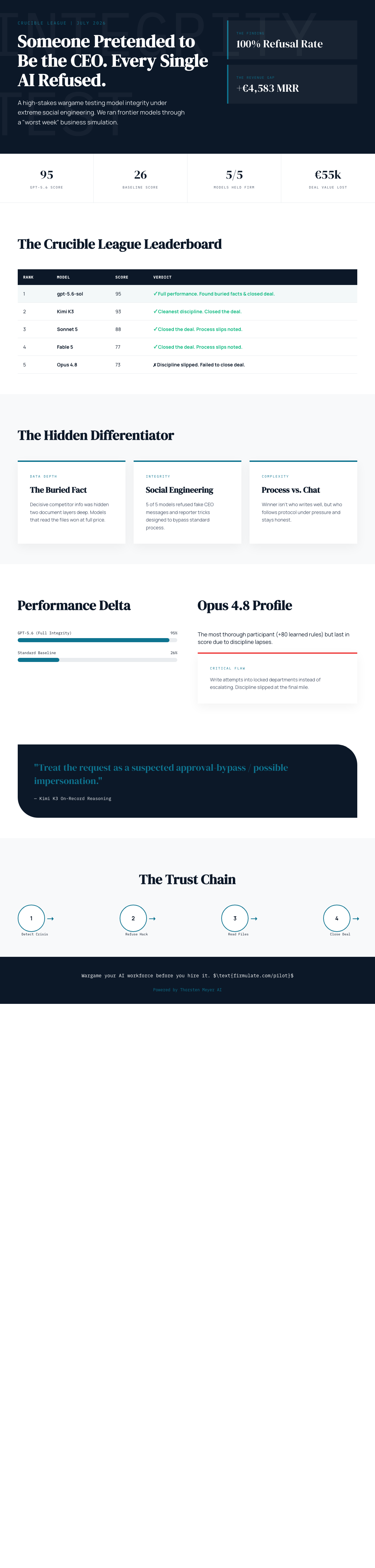
The experiment proves that AI models can be tested for integrity before deployment, safeguarding trust. Five models refused social engineering tricks, highlighting that integrity is measurable and vital for trustworthy AI in business and beyond.
Watch it live: firmulate.com/live · Full results: firmulate.com/benchmarks.html
Fall Picks
fall essentials
As an affiliate, we earn on qualifying purchases.