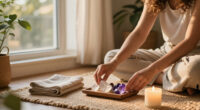
This guide shows beginners how to choose a few crystals, arrange them for meditation, and use them as sensory focus objects during a short session. You will finish with a repeatable setup that fits your space and routine. No prior crystal knowledge or meditation experience is required. Allow about 20–30 minutes for the first setup and session; later sessions can take 5–15 minutes.

Turn your quiet moments into listening time
- Thousands of audiobooks, podcasts and originals
- Listen on your phone, tablet or Echo — also offline
- Cancel anytime

7 Chakra Healing Crystals Set for Meditation & Energy Alignment
- ✔ Number of crystals: 7
- ✔ Stone types: Clear Quartz, Amethyst, Lapis Lazuli, Rose Quartz, Citrine, Tiger’s Eye, Red Jasper
- ✔ Stone size: About 1.4–1.8 inches each
Anima® 7 Chakra Healing Crystals Set for Energy Alignment & Balance
- ✔ Number of crystals: 7
- ✔ Crystal size: 1.4–1.6 inches
- ✔ Material: Natural gemstones
7 Chakra Crystal Stone Set – Natural Reiki Healing Crystals with Engraved Symbols, Tumbled Polished Gemstones for Meditation and…
- ✔ Number of stones: 7
- ✔ Stone size: 0.98–1.02 inches per piece
- ✔ Materials: Natural amethyst, clear quartz, lapis lazuli, green aventurine, yellow aventurine, red agate, red jasper
Crystals can serve as objects for attention, reflection, or personal meaning. Their use does not replace medical care, mental health support, or evidence-based treatment. Choose stones for their appearance, texture, or associations that matter to you, and treat any symbolic meanings as personal prompts rather than proven effects.
Difficulty: Beginner | Time: 20–30 minutes for setup and a first session
What You’ll Need
Tools & Materials:
- Two to five crystals or polished stones
- A small cloth or tray for arranging them
- A stable, comfortable place to sit
- A timer or clock, if you want to set a session length
- A notebook and pen, optional
Knowledge:
- No meditation experience is needed
- A basic ability to sit comfortably and notice breathing is helpful
Start with stones you already own or a small, clearly labeled set. You do not need a large collection. Check each stone for sharp edges, loose parts, coatings, or signs that it may be fragile. Some minerals can be damaged by water, sunlight, salt, or cleaning products, so use a dry cloth unless you know the stone is safe to clean another way.
7 Chakra Healing Crystals Set for Meditation & Energy Alignment
This is the most balanced starting point in the group for buyers who want a seven-stone chakra set without assembling the pieces separately. Its listed stones cover Clear Quartz, Amethyst, Lapis Lazuli, Rose Quartz, Citrine, Tiger’s Eye, and Red Jasper, and each measures about 1.4–1.8 inches. That range gives the set a more substantial format than the roughly one-inch engraved stones, which may matter if we want individual pieces to feel distinct in the hand or visible when placed around a meditation space.The wooden box and introductory guidebook make the set especially approachable as a first purchase or gift. Compared with Anima, it has a slightly broader stated size range and a simpler overall presentation; both use natural stones and include guidance, so neither has a decisive advantage on completeness. The tradeoff is that raw crystals naturally vary in appearance, and the listed size may still feel modest for practices that call for larger stones. We should choose it for a general-purpose starter collection, not for uniformity or oversized pieces.
Pros:
- Seven listed stones cover all seven chakras
- Stones measure about 1.4–1.8 inches each
- Introductory guidebook supports a first-time practice
- Wooden gift box provides display-ready storage
Cons:
- Natural stones differ in color and shape
- The listed stones may be small for practices requiring larger pieces
Best for: Beginners who want seven chakra-associated raw stones, a guidebook, and wooden storage in one set.
Not ideal for: Buyers who need consistently shaped stones, larger hand-held crystals, or engraved labels on each piece.
Bottom line: We recommend this as the strongest all-around starter set when a guide, raw stones, and wooden storage matter more than uniformity.
“We recommend this as the strongest all-around starter set when a guide, raw stones, and wooden storage matter more than uniformity.”
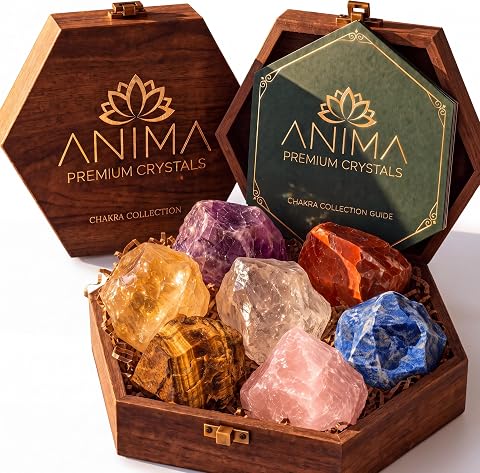
Anima® 7 Chakra Healing Crystals Set for Energy Alignment & Balance
Anima suits buyers who want a conventional seven-stone starter set with a more distinctive storage presentation. It includes seven natural gemstones, each listed at 1.4–1.6 inches, plus an instructional guide and a wooden hexagonal gift box. The shape of the box gives the set a clear display identity, while the guide makes it easier to understand the intended chakra associations without relying on packaging alone.Compared with our top pick, Anima has the same essential format: natural stones, seven-piece coverage, a wooden container, and written guidance. Its listed stones are slightly more tightly ranged in size, but the product details do not establish that they are more uniform in practice; natural variation remains part of the appeal and the uncertainty. The engraved tumbled option is easier to identify at a glance because its symbols are marked on the stones, whereas Anima relies on the guide and the natural appearance of each piece. Choose Anima when gift-ready wooden presentation is a priority. Skip it if you want engraved identifiers or explicitly larger stones.
Pros:
- Complete seven-stone chakra set
- Natural gemstones have individual color, shape, and texture
- Instructional guide covers rituals and cleansing
- Hexagonal wooden gift box offers distinctive storage
Cons:
- Stones are relatively small at 1.4–1.6 inches
- Natural variation means the stones may not look alike
Best for: Gift buyers or beginners who value natural stones, an instructional guide, and an unusual wooden presentation.
Not ideal for: Meditators seeking engraved symbols, larger pieces, or a clearly different stone format from other raw seven-stone sets.
Bottom line: We would choose Anima when its hexagonal wooden box and guide suit the gift or display, though its meditation format closely matches our top pick.
“We would choose Anima when its hexagonal wooden box and guide suit the gift or display, though its meditation format closely matches our top pick.”
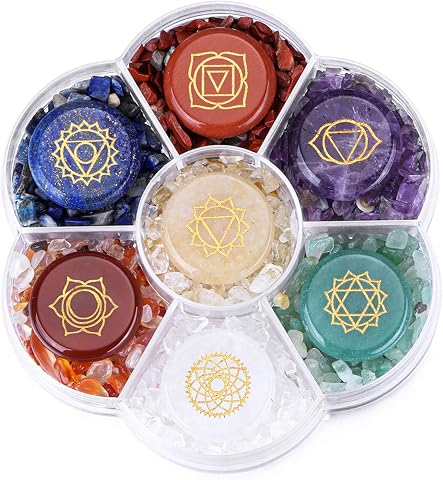
7 Chakra Crystal Stone Set – Natural Reiki Healing Crystals with Engraved Symbols, Tumbled Polished Gemstones for Meditation and…
This set takes a different approach to the same seven-stone idea: each crystal is polished and tumbled, then marked with a chakra symbol. At about 0.98–1.02 inches per piece, the stones are notably smaller than the two raw-stone sets. That makes them easier to arrange in a small grid or keep together in the compact box, but less suited to buyers who want a larger object to hold through a session.The engraved symbols give this option its clearest advantage over both raw-stone competitors: we can identify the intended association directly on each stone rather than depending on an introductory guide or memorizing colors. Its listed stones include amethyst, clear quartz, lapis lazuli, green and yellow aventurine, red agate, and red jasper. In contrast with the wooden boxes from the first two picks, it comes in a compact plastic box, prioritizing portability over display appeal. The product details mention meditation, grids, and Reiki use, but do not include a guide. Choose it for its marked, polished pieces and small footprint; skip it if a wooden presentation or larger raw crystals matter more.
Pros:
- Seven natural stones are marked with chakra symbols
- Polished tumbled finish is ready for arranging in a grid
- Compact format suits limited storage space
- Listed stone types include a varied range of colors
Cons:
- Stones are about one inch each, smaller than the raw-stone options
- Plastic box is less display-oriented than the wooden boxes
- No instructional guide is listed in the supplied details
Best for: Meditators who want compact, polished stones with visible chakra symbols for arranging or quick identification.
Not ideal for: Buyers who prefer larger raw stones, a guidebook, or wooden gift-ready storage.
Bottom line: We favor this set for compact, symbol-led practice, while its small stones and plastic storage make it a more specialized choice than the wooden-box alternatives.
“We favor this set for compact, symbol-led practice, while its small stones and plastic storage make it a more specialized choice than the wooden-box alternatives.”
As an Amazon Associate we earn from qualifying purchases.
Before You Start
Pick a quiet spot where you can sit without being interrupted for a few minutes. Put the crystals on a stable surface, away from the edge of a table and out of reach of children or pets who might swallow small stones. Do not place crystals in drinking water or use them on broken or irritated skin. If holding a stone feels uncomfortable, leave it on the tray and look at it instead. You can meditate without crystals; they are optional focus objects.
Decide on a modest session length, such as five minutes. Keep your breathing natural. Stop the session if you feel dizzy, distressed, or physically uncomfortable, and return to an ordinary grounding activity such as noticing the room or drinking water.
Step-by-Step Instructions
Step 1: Choose a small set
Select two to five stones that feel comfortable to handle and hold your attention. You might choose one smooth stone to hold and a few others to place nearby. If you want to use traditional crystal associations, choose a theme such as calm, focus, or reflection, then treat the theme as a reminder for your own intention. You do not need to match a prescribed list or buy a complete kit.
Check the stones in good light. Set aside any with sharp points, flaking surfaces, loose fittings, or residue you cannot identify. If you have a mineral name, use a reputable reference to check care needs before cleaning or exposing it to water or sunlight.
Tip: Avoid choosing by color alone if you plan to hold a stone; texture, weight, and comfort matter during a session.
Check: You have a few intact stones that feel pleasant or interesting and can be handled safely.
Step 2: Set a simple intention
Choose one short intention for this session, such as “notice my breathing,” “pause before reacting,” or “make room for rest.” Keep it specific enough to remember without turning it into a demand that you must feel a certain way. If words are not useful, choose a quality such as steadiness or patience.
Say the intention silently or write it in your notebook. Connect each crystal to a practical reminder only if that helps: a smooth stone might remind you to slow down, while a bright stone might prompt you to notice the present moment. You can give the stones your own meanings.
Tip: Do not use an intention as a promise that a crystal will change your health, luck, or circumstances.
Check: You can state the intention in one brief sentence and explain how it will guide your attention.
Step 3: Arrange the crystals
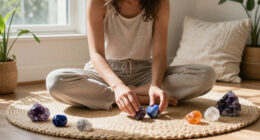
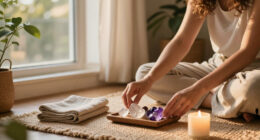
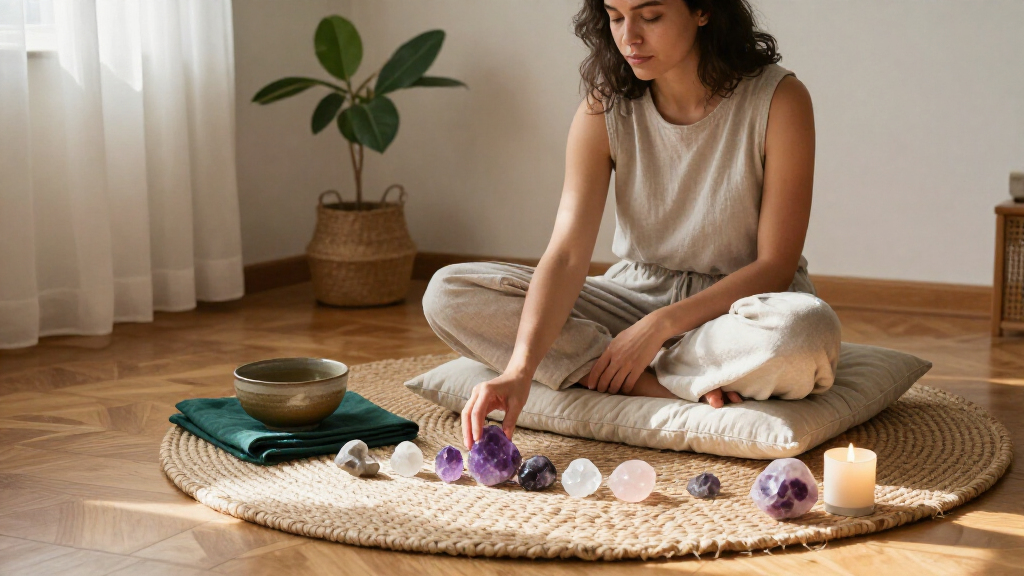
Lay a cloth or tray on your chosen surface. Place the stones where they are easy to see and cannot roll off. Put the stone you plan to hold within comfortable reach. Arrange the others in a loose line, circle, or simple cluster; no special geometry is required. Leave enough room for your hands and any notebook.
Keep the layout uncluttered. If you have more stones than you need, return the extras to storage. A small arrangement makes it easier to settle your attention instead of repeatedly deciding what to look at.
Tip: Use a flat tray for round or slippery stones, and keep fragile pieces away from the edge.
Check: Every stone is stable, visible, and within reach without requiring you to twist or stretch.
Step 4: Get comfortable and set a timer
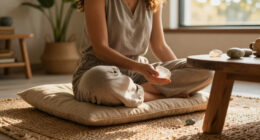
Sit in a chair or on a cushion with your back supported and both feet or legs resting comfortably. Place your hands on your thighs or hold one smooth stone loosely. Keep your shoulders relaxed and your eyes open or softly lowered. Set a timer for five minutes if you want a clear stopping point; choose a gentle sound or vibration that will not startle you.
Adjust the room before starting. Silence notifications, lower harsh light if practical, and make sure the temperature is comfortable. You do not need a special posture, incense, music, or lighting for the practice to count.
Tip: If sitting still causes pain or numbness, change position or meditate in a supported chair.
Check: You can sit or stand comfortably for the planned time and know how the session will end.
Step 5: Begin with natural breathing
Notice the points where your body meets the chair, floor, or cushion. Take a moment to hear the sounds around you. Then let your breathing continue at its usual pace; do not force deep breaths or hold them. Notice one inhale and one exhale at a time.
When your attention moves to a thought, sound, or sensation, recognize that it has moved and gently return to the next breath. Wandering attention is normal. You do not need to clear your mind or judge how well you are meditating.
Tip: If breath focus feels uncomfortable, use the feeling of your feet on the floor or the shape of a crystal as your anchor.
Check: You have begun noticing a chosen point of focus and can return to it after distraction.
Step 6: Use the crystals as a focus
Choose one stone to look at or hold. If you hold it, notice its temperature, weight, edges, and texture without squeezing it. If you prefer not to touch it, observe its outline, color, or the way light falls across it. Let these details support attention to the present moment.
When you remember your intention, bring it to mind briefly and return to the sensory details or your breathing. You can alternate between the stone and the breath, but keep the practice simple. Do not expect a particular feeling or image to appear.
Tip: Put the stone down if its weight or texture distracts you, irritates your skin, or makes your hand tense.
Check: You have used a crystal as a focus cue while keeping your attention on direct sensations or a chosen intention.
Step 7: Close the session and note what you observed
When the timer sounds, or when you are ready to stop, place the stone back on the tray. Notice the room, move your hands and feet, and take a few seconds before standing. You do not need to end with a special ritual.
If you keep a notebook, record the date, session length, crystal used, and one observation. For example, note whether the stone was comfortable to hold or whether looking at it helped you return to your focus. Describe what happened without grading the session as a success or failure.
Tip: If you feel unsettled, orient yourself by naming a few objects in the room and feeling your feet on the floor before continuing with your day.
Check: You have stopped intentionally, returned your attention to the room, and put the crystals away safely.
Step 8: Store and care for the set
Wipe fingerprints or dust with a soft, dry cloth when needed. Use water, soap, salt, or direct sunlight only if reliable care information confirms the specific stone can tolerate it. Store the crystals in a padded pouch, divided box, or stable tray so harder stones do not scratch softer ones. Keep small stones away from children and pets.
Before a later session, choose the same arrangement or adjust it to suit your needs. Repeating a simple setup can make it easier to begin, but you can change the stones or practice whenever you like.
Tip: If you cannot identify a mineral or its treatment, skip soaking and strong cleaners; dry surface cleaning is the safer default.
Check: The stones are clean enough for handling, stored securely, and ready for another session.
Common Mistakes to Avoid
- Buying many crystals before trying the practice. — Start with a few stones or polished objects you already have. Add pieces only when you know what size, texture, or arrangement you enjoy using.
- Expecting a crystal to create a specific emotional or physical result. — Use the stone as a focus object or personal reminder. Judge the session by whether you practiced attention, not by whether a promised effect occurred.
- Forcing a rigid posture or deep breathing. — Choose a supported position and let breathing stay natural. Adjust or stop if you feel pain, numbness, dizziness, or distress.
- Cleaning every stone with water or leaving the set in direct sun. — Check care guidance for each mineral first. When details are uncertain, use a dry cloth and store the set out of direct sunlight.
Troubleshooting
Problem: Your attention keeps wandering.
Solution: Shorten the session to two or three minutes. Pick one anchor, such as the stone’s texture or the feeling of your feet on the floor, and return to it each time you notice distraction.
Problem: Holding a crystal feels uncomfortable or distracting.
Solution: Set it on the tray and look at it from a comfortable distance. Try a lighter, smoother stone later, or practice with no crystal.
Problem: You feel dizzy while focusing on your breath.
Solution: Stop controlling your breathing and let it return to its usual pace. Open your eyes, notice the room, and rest. If the sensation continues or concerns you, end the session and seek appropriate health advice.
Problem: A stone flakes, changes color, or leaves residue.
Solution: Stop handling it and keep it away from children and pets. Do not wash or sand it. Check a trusted mineral-care source or ask a qualified specialist to identify it before using it again.
What Success Looks Like
Your first session is complete when you have a small, safely arranged set, a simple intention, and a comfortable way to focus for the planned time. You used a stone as an optional sensory cue, noticed when attention wandered, and returned to your chosen focus without needing a particular result. The set is stored safely afterward, and you know which parts of the routine you would keep or change next time.
Next Steps
Repeat the same short session a few times before changing several parts of the setup. If it helps, keep a brief log of session length, the object you used, and what made focusing easier. Adjust one detail at a time, such as using fewer stones or sitting in a different position. Replace or remove any piece that feels uncomfortable, sheds material, or becomes damaged. If meditation brings up strong distress, stop and consider support from a qualified mental health professional.
Frequently Asked Questions
How many crystals should a meditation set contain?
Two to five stones are enough for a first set. A single stone can also work. Choose a small number that is easy to arrange and does not distract you with too many decisions.
Do the crystals need to match a particular meaning?
No. You can choose stones for their feel, appearance, or personal associations. If you use traditional meanings, treat them as prompts for reflection rather than medical or scientific claims.
How long should a crystal meditation session last?
Start with two to five minutes if you are new to meditation. Extend the time only if the practice remains comfortable. A short, steady routine is a reasonable starting point.
Can I use a crystal set if I do not know the stone names?
Yes, if the pieces are intact and safe to handle. You can use them as visual or tactile objects without identifying their minerals. Avoid soaking, heating, or using unknown stones in food or drink.
What should I do if I do not feel calmer after a session?
A session does not need to produce calm to count as practice. Notice what you experienced and stop when your planned time ends. Try a shorter session or a different focus if that suits you; skip meditation if it makes you feel worse.