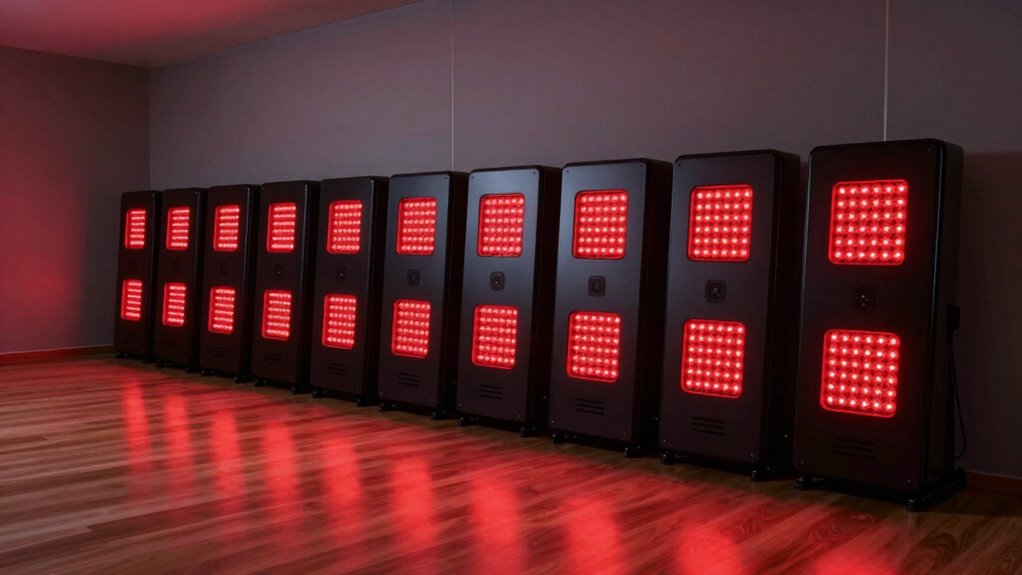

For a near-infrared red light panel for recovery, my best overall pick is the Hooga PRO300, which offers a panel format suited to regular, targeted sessions. The Hooga HG200 stands out as a smaller-panel alternative, while the Comfytemp mat suits buyers who prefer a flexible surface over a standing device. The main tradeoffs are coverage, setup, and how easily a device fits your routine: a larger panel can cover more area, while a lamp or mat may be easier to position around specific body parts. Wavelength labels alone do not tell the full story, so it is also worth checking usable coverage, controls, and manufacturer guidance. Read on for my full comparison and a guide to choosing the format that fits your recovery routine.

Turn your quiet moments into listening time
- Thousands of audiobooks, podcasts and originals
- Listen on your phone, tablet or Echo — also offline
- Cancel anytime
Key Takeaways
- Panel size changes the use case: the Hooga HG200 and HG300 offer distinct footprints, while a compact panel such as the BestQool BQ60 is better suited to targeted use than broad coverage.
- 660nm and 850nm appear across many picks: wavelengths are not enough to rank devices; output information, treatment area, positioning, and session guidance also matter.
- Stands and lamps favor flexible positioning: the Puroth and several Viconor models can suit users who want to direct light at a particular area, though their setup differs from a fixed panel.
- Different formats solve different routine problems: the Comfytemp mat and INIA 2-in-1 panel-and-belt offer alternatives to holding a consistent position in front of a panel.
- Brand and wattage labels do not settle the comparison: the Hooga, BestQool, VEVOR, and other panel listings still need to be judged by verified specifications, coverage, controls, and ease of use.
| Puroth Red and Near-Infrared Light Therapy Lamp with Adjustable Stand |  | Best for Adjustable Home Positioning | Panel size: 11 × 14.5 inches | LED configuration: 180 beads with 540 chips | Wavelengths: 660 nm red and 850 nm near-infrared | VIEW ON AMAZON | See Our Full Breakdown |
| Viconor Red Light Therapy Panel for Body, 660nm/850nm Near Infrared, 60 Dual-Chip LED, 300W |  | Best for Output Details and Wall Mounting | LED count: 60 dual-chip LEDs, 120 effective beads | Wavelengths: 660 nm red and 850 nm near-infrared | Power: 300 W | VIEW ON AMAZON | See Our Full Breakdown |
| 660nm Red and 850nm Near-Infrared Light Therapy Panel with Adjustable Stand |  | Best for Customizable Session Controls | Wavelengths: 660 nm red and 850 nm near-infrared | Light modes: Constant light, low-frequency flicker, and high-frequency flicker | Brightness levels: 6: 10%, 20%, 40%, 60%, 80%, and 100% | VIEW ON AMAZON | See Our Full Breakdown |
| Viconor Red Light Therapy for Face and Body, Red Infrared Light Therapy Lamp with Stand |  | Best for Curved, Close-Range Positioning | LED count: 120 LEDs | LED chip configuration: Each LED includes one 660 nm red chip and two 850 nm infrared chips | Wavelengths: 660 nm red and 850 nm infrared | VIEW ON AMAZON | See Our Full Breakdown |
| Comfytemp Red Light Therapy Mat for Body, 33” x 17”, 660nm & 850nm |  | Best for Seated or Lying-Down Use | Mat dimensions: 33 × 17 inches | LED count: 480 LEDs | Wavelengths: 660 nm red and 850 nm near-infrared | VIEW ON AMAZON | See Our Full Breakdown |
| Viconor Red Light Therapy Lamp for Face and Body with Stand |  | Best for Flexible Positioning | Brand: Viconor | LED count: 120 | Wavelengths: 660 nm red and 850 nm near-infrared | VIEW ON AMAZON | See Our Full Breakdown |
| Hooga HG200 Red and Near-Infrared Light Therapy Panel |  | Best Compact Panel for Beginners | Wavelengths: 660 nm red and 850 nm near-infrared | LED count: 40 | Power: 48 watts | VIEW ON AMAZON | See Our Full Breakdown |
| XMZXMZ Red Light Therapy Panel with 660nm and 850nm LEDs |  | Best for Adjustable Coverage and Controls | Wavelengths: 660 nm red and 850 nm near-infrared | LED count: 486 total: 324 red and 162 near-infrared | Panel size: 8 × 14.5 inches | VIEW ON AMAZON | See Our Full Breakdown |
| BestQool BQ60 Red Light Therapy Panel, 660nm Red and 850nm Near-Infrared, 105W |  | Best for Flexible Mounting | Power: 105 watts | Wavelengths: 660 nm red and 850 nm near-infrared | Irradiance: 95.6 mW/cm² at 3 inches | VIEW ON AMAZON | See Our Full Breakdown |
| Hooga PRO300 Red Light Therapy Panel, 660nm Red and 850nm Near-Infrared LEDs |  | Best for Larger, Mountable Setups | Wavelengths: 660 nm red and 850 nm near-infrared | LEDs: 60 dual-chip LEDs; listing also makes a conflicting 900-LED claim | Power: 300 watts | VIEW ON AMAZON | See Our Full Breakdown |
| INTEO Red Light Therapy Lamp for Face and Body |  | Best for Flexible Positioning | Wavelengths: 660 nm red; 850 nm near-infrared | Panel dimensions: 13 × 7.5 inches | Maximum device height: 46.5 inches | VIEW ON AMAZON | See Our Full Breakdown |
| 45W Red Light Therapy LED Panel with 660nm Red and 850nm Near-Infrared Light |  | Best for Simple At-Home Placement | Power: 45 W | Wavelengths: 660 nm red; 850 nm near-infrared | Intended use: At-home light therapy | VIEW ON AMAZON | See Our Full Breakdown |
| VEVOR 80W Red Light Therapy Panel with 60 Dual-Chip LEDs |  | Best for Compact Floor-Mounted Sessions | Power: 80 W | LEDs: 60 dual-chip LEDs | Wavelengths: 660 nm red; 850 nm near-infrared | VIEW ON AMAZON | See Our Full Breakdown |
| Hooga HG300 Red and Near-Infrared Light Therapy Panel |  | Best for Targeted Starter Sessions | Model: HG300 | Wavelengths: 660 nm red; 850 nm near-infrared | LEDs: 60 | VIEW ON AMAZON | See Our Full Breakdown |
| INIA 2-in-1 Red Light Therapy Panel and Belt |  | Best for Wearable Recovery Routines | Design: Panel and wearable belt | Wavelengths: 630 nm, 660 nm, 850 nm, 1064 nm | LED count: 360 | VIEW ON AMAZON | See Our Full Breakdown |
| near infrared red light panel for recovery | Wavelengths |
|---|---|
| Puroth Red and Near-Infrared L | 660 nm red and 850 nm near-infrared |
| Viconor Red Light Therapy Pane | 660 nm red and 850 nm near-infrared |
| 660nm Red and 850nm Near-Infra | 660 nm red and 850 nm near-infrared |
| Viconor Red Light Therapy for | 660 nm red and 850 nm infrared |
| Comfytemp Red Light Therapy Ma | 660 nm red and 850 nm near-infrared |
| Viconor Red Light Therapy Lamp | 660 nm red and 850 nm near-infrared |
| Hooga HG200 Red and Near-Infra | 660 nm red and 850 nm near-infrared |
| XMZXMZ Red Light Therapy Panel | 660 nm red and 850 nm near-infrared |
| BestQool BQ60 Red Light Therap | 660 nm red and 850 nm near-infrared |
| Hooga PRO300 Red Light Therapy | 660 nm red and 850 nm near-infrared |
| INTEO Red Light Therapy Lamp f | 660 nm red; 850 nm near-infrared |
| 45W Red Light Therapy LED Pane | 660 nm red; 850 nm near-infrared |
| VEVOR 80W Red Light Therapy Pa | 660 nm red; 850 nm near-infrared |
| Hooga HG300 Red and Near-Infra | 660 nm red; 850 nm near-infrared |
| INIA 2-in-1 Red Light Therapy | 630 nm, 660 nm, 850 nm, 1064 nm |
More Details on Our Top Picks
Puroth Red and Near-Infrared Light Therapy Lamp with Adjustable Stand
The Puroth stands out for buyers who want a larger 11 × 14.5-inch panel and more control over where it points. Its adjustable 45–60-inch stand and rotating head make it easier to aim at different areas than the fixed-placement Viconor 300W panel, while five brightness levels and preset timers allow a more tailored routine. The listed 660 nm red and 850 nm near-infrared wavelengths match the common dual-wavelength setup in this roundup, but the product details do not provide irradiance figures, so I would not rank it by claimed treatment intensity. It is a flexible floor-or-tabletop option, though assembly and the stand take more space than a compact panel. Buyers seeking measured output or a simpler wall-mounted setup should compare it with the Viconor panel instead.
Pros:- 11 × 14.5-inch panel offers broader coverage than smaller compact panels
- Adjustable stand and 360° rotating head support varied positioning
- Five brightness levels and five preset timer choices provide session flexibility
- Includes remote control, safety glasses, and eye cover
Cons:- Assembly is required, and the floor stand needs storage space
- No irradiance measurement or performance results are provided
- The listed timer choices begin at 20 minutes, limiting shorter preset sessions
Best for: Home users who want a stand-mounted panel they can reposition between different body areas and use from a chair or tabletop
Not ideal for: Buyers who need published irradiance data, a compact setup, or a panel that does not require assembly
- Panel size:11 × 14.5 inches
- LED configuration:180 beads with 540 chips
- Wavelengths:660 nm red and 850 nm near-infrared
- Stand height:45–60 inches
- Lamp head:360° rotatable
- Brightness levels:5
- Preset timers:20, 30, 40, 50, and 60 minutes
- Use and included accessories:Floor or tabletop; adjustable stand, stable base, remote, power adapter, safety glasses, eye cover, and manual
Our verdict“Choose the Puroth if adjustable, stand-based positioning matters more to you than published output measurements or a small footprint.”
Viconor Red Light Therapy Panel for Body, 660nm/850nm Near Infrared, 60 Dual-Chip LED, 300W
The Viconor earns a distinct place for shoppers who want published output information and a panel that can mount on a wall or sit on a table. Its stated 140 mW/cm² irradiance at 6 inches gives buyers a reference point missing from the Puroth and the adjustable-stand panel in this group, although that figure alone does not establish recovery outcomes. The 60 dual-chip LEDs deliver both 660 nm red and 850 nm near-infrared light, and the built-in fan addresses heat during use. Compared with the larger Puroth, this model has fewer positioning options and its single panel may cover less area; its 5–30-minute timer also provides a shorter range than the Puroth’s presets. I would favor it for a fixed home spot, not for treating broad areas without repositioning.
Pros:- Lists irradiance of 140 mW/cm² at 6 inches
- Dual wavelengths combine 660 nm red and 850 nm near-infrared
- Built-in fan and 5–30-minute timer support controlled sessions
- Includes hanging hardware and eye protection for wall or tabletop placement
Cons:- Single panel size may require repositioning for larger areas
- No independent clinical testing or certifications are specified
- Wall mounting offers less flexible aiming than the Puroth’s rotating stand
Best for: Buyers who want a table- or wall-mounted panel with a stated irradiance figure and a short built-in timer
Not ideal for: People seeking broad body coverage in one position or a stand that can be adjusted around a seated or lying posture
- LED count:60 dual-chip LEDs, 120 effective beads
- Wavelengths:660 nm red and 850 nm near-infrared
- Power:300 W
- Irradiance:140 mW/cm² at 6 inches
- Timer:5–30 minutes
- Cooling:Built-in cooling fan
- Placement:Tabletop or wall-mounted
- Included accessories:Manual, hanging kit, hooks, and eye protection
Our verdict“Pick this Viconor if a stated irradiance figure and wall-mount option matter more than broad coverage or stand adjustability.”
660nm Red and 850nm Near-Infrared Light Therapy Panel with Adjustable Stand
This adjustable-stand panel is the control-focused choice: it offers six brightness levels, three light modes, and six timer settings with automatic shut-off. That range gives users more ways to adjust a session than the Puroth, which has five brightness levels and presets but no listed light modes. Its foldable stand also suits buyers who need to change positioning and store the unit away afterward. The tradeoff is a thinner evidence picture: unlike the Viconor 300W panel, this product provides no irradiance or treatment-area figures, so I cannot compare its stated output or estimate how much area it covers. The flicker modes may appeal to buyers who want selectable settings, but the listing does not explain their purpose. I’d choose it for control and foldability, not for documented output strength.
Pros:- Six brightness settings allow finer adjustment than the Puroth’s five levels
- Three selectable modes include constant light and two flicker options
- Timer offers six settings from 10 to 60 minutes with automatic shut-off
- Foldable adjustable stand supports positioning and easier storage
Cons:- No irradiance or treatment-area specifications are provided
- The listed details do not explain the intended use of the flicker modes
- Only protective glasses are listed among the included accessories
Best for: Home users who value several brightness and timer choices, automatic shut-off, and a stand that folds for storage
Not ideal for: Buyers comparing panels by irradiance or treatment-area coverage, since those figures are not provided
- Wavelengths:660 nm red and 850 nm near-infrared
- Light modes:Constant light, low-frequency flicker, and high-frequency flicker
- Brightness levels:6: 10%, 20%, 40%, 60%, 80%, and 100%
- Timer:10, 20, 30, 40, 50, or 60 minutes
- Automatic shut-off:Yes
- Stand:Adjustable and foldable
- Included accessory:Protective glasses
Our verdict“Choose this panel if adjustable session controls and fold-away storage outrank published output and coverage data.”
Viconor Red Light Therapy for Face and Body, Red Infrared Light Therapy Lamp with Stand
The curved head and included stand make this Viconor a better fit for targeted face or body positioning than the flat Viconor 300W panel, which is designed for tabletop or wall mounting. Its listed 120 LEDs each contain one 660 nm red light and two 850 nm infrared lights, and the stand allows height and angle adjustment across a stated 180° range. That shape may make it easier to aim at a smaller area while seated, but the product description’s broad claims about tissue effects and skin results are not supported here by output measurements or clinical evidence. Unlike the Puroth, it lacks a panel-size figure, brightness controls, and timer details, leaving buyers with less information for comparing sessions. I’d consider it for flexible, localized placement, but not as the most transparent choice for recovery-focused panel shopping.
Pros:- Curved lamp design is intended to focus light toward a smaller target area
- 120 LEDs combine 660 nm red and 850 nm infrared chips
- Included stand and hook allow more than one placement method
- Stated 180° adjustment range supports changes in height and angle
Cons:- No irradiance or panel dimensions are provided
- Timer and brightness controls are not specified
- Claims about recovery, circulation, and skin effects are not accompanied by performance evidence
Best for: Buyers who want a lightweight, curved lamp with an included stand for directing light toward a particular area at home
Not ideal for: Shoppers who need quantified irradiance, known panel dimensions, or documented timer and brightness controls
- LED count:120 LEDs
- LED chip configuration:Each LED includes one 660 nm red chip and two 850 nm infrared chips
- Wavelengths:660 nm red and 850 nm infrared
- Lamp design:Curved surface
- Adjustment:Stand adjusts through a stated 180° range
- Placement:Can be hung or placed independently
- Included accessories:Hook, 1.8 m power cord, and stand
Our verdict“Consider this Viconor for adjustable, targeted positioning, but choose a better-documented panel if output and session controls guide your decision.”
Comfytemp Red Light Therapy Mat for Body, 33” x 17”, 660nm & 850nm
The Comfytemp takes a different approach from the rigid panels here: its 33 × 17-inch flexible mat is designed to rest against or beneath the body while sitting or lying down. That form factor may suit people who want coverage across a larger contact area without aiming a stand, whereas the Puroth and both Viconor panels need deliberate positioning in front of the user. The mat lists 480 LEDs, four modes, and three intensity levels, but it does not specify irradiance, timer settings, or what each mode changes. Those omissions make it harder to compare expected output with the Viconor 300W panel, which provides an irradiance figure. I’d shortlist the Comfytemp for convenience and broad mat-style placement, while buyers who want a stand, published output, or detailed session controls should look elsewhere.
Pros:- 33 × 17-inch mat provides a broad area for seated or lying-down use
- 480 LEDs are specified for the mat
- Four modes and three adjustable levels offer selectable settings
- Simple connection-and-button operation avoids panel assembly or mounting
Cons:- No irradiance figure is provided for comparison with the Viconor 300W panel
- Timer settings and automatic shut-off are not specified
- A mat is less suited than the Puroth to directing light at a chosen area from a distance
Best for: People who prefer a flexible light mat for seated or lying-down sessions rather than standing in front of a panel
Not ideal for: Buyers who need a stand-mounted light source, stated irradiance, or specified timer settings and mode functions
- Mat dimensions:33 × 17 inches
- LED count:480 LEDs
- Wavelengths:660 nm red and 850 nm near-infrared
- Light modes:4
- Adjustable levels:3
- Use positions:Sitting or lying down
- Operation:Connect the pad and adapter, then press the button
Our verdict“Choose the Comfytemp if you want a broad mat-style setup for seated or lying-down use and can accept limited output details.”
Viconor Red Light Therapy Lamp for Face and Body with Stand
The Viconor lamp makes sense for recovery routines that shift between body areas: its curved 120-LED panel can stand on a surface or hang, while the included stand adjusts through 180 degrees. That flexibility is more useful for changing your treatment angle than the compact, fixed tabletop footprint of the Hooga HG200. It pairs 660 nm red light with 850 nm near-infrared, matching the wavelengths used by several panels here, but the provided details do not give irradiance or panel dimensions, so it is harder to judge output and coverage before buying. The 3 m cord adds placement freedom. I’d choose it for adaptable home positioning, not for buyers who need clearly documented output or a defined treatment area.
Pros:- Combines 660 nm red and 850 nm near-infrared light
- Curved panel can be hung or placed independently
- Stand adjusts through 180 degrees for changing the angle
- Includes a 3 m power cord for more flexible placement
Cons:- No irradiance figure or panel dimensions are provided
- The suggested daily session of 15–30 minutes is not paired with product-specific output guidance
Best for: Home users who want to reposition a panel between face and body areas and value a movable stand or hanging option.
Not ideal for: Buyers comparing panels by stated irradiance or treatment-area dimensions, since those details are not provided.
- Brand:Viconor
- LED count:120
- Wavelengths:660 nm red and 850 nm near-infrared
- Panel design:Curved, portable panel
- Stand adjustment:180°
- Included accessories:Hook, 3 m power cord, and stand
- Suggested use:15–30 minutes daily
Our verdict“Choose the Viconor if flexible placement matters more to you than having published irradiance and coverage figures.”
Hooga HG200 Red and Near-Infrared Light Therapy Panel
The Hooga HG200 is the easiest fit here for a first recovery-focused setup that needs to stay on a desk or side table. Its 9.8 × 6.3-inch footprint and adjustable stand make it less demanding to place than the larger Hooga PRO300, while selectable red, near-infrared, or combined modes let you choose how to run each session. A built-in timer and cooling fan add practical control during home use, and the listed irradiance gives buyers a measurement point the Viconor lamp does not provide. The tradeoff is its modest panel size: it suits targeted areas rather than broad coverage. It also requires eye protection, is indoor-only, and should not be treated as a water-resistant device.
Pros:- Offers red, near-infrared, and combined light modes
- Compact dimensions and adjustable tabletop stand suit small spaces
- Built-in timer and cooling fan support straightforward home sessions
- Includes a 3-year manufacturer warranty
Cons:- Small panel is better suited to targeted areas than broad body coverage
- Indoor use only and not water resistant
- Requires eye protection; users should not look directly at the LEDs
Best for: New panel users who want a compact tabletop device, simple session timing, and selectable red and near-infrared modes.
Not ideal for: People seeking a larger treatment area or a panel suited to damp spaces or outdoor use.
- Wavelengths:660 nm red and 850 nm near-infrared
- LED count:40
- Power:48 watts
- Irradiance:Over 90 mW/cm² at 6 inches
- Modes:Red, near-infrared, or both
- Dimensions:9.8 × 6.3 × 1.2 inches
- Features:Built-in timer, cooling fan, and adjustable tabletop stand
- Warranty:3 years
Our verdict“Pick the HG200 for a compact, feature-equipped introduction to targeted red and near-infrared panel sessions.”
XMZXMZ Red Light Therapy Panel with 660nm and 850nm LEDs
The XMZXMZ panel gives home users more session adjustments than the simpler Hooga HG200: five brightness levels, a remote, and timer presets from 20 to 60 minutes make it easier to tailor operation without reaching for the unit. Its 8 × 14.5-inch panel and adjustable gooseneck can be aimed at areas such as the back, arms, or legs, while 486 LEDs provide a much denser array than the HG200’s 40. That does not, by itself, establish irradiance or prove faster recovery, and no output figure is supplied. The stand and glasses are included, but the stand and panel need room at home. I’d favor this model for adjustability and positioning, not for shoppers seeking independently comparable output data.
Pros:- Combines 660 nm red and 850 nm near-infrared LEDs
- Five brightness levels and an adjustable gooseneck allow changes to setup
- Remote control and multiple preset timers simplify operation
- Includes a stand and protective glasses
Cons:- Panel and stand require dedicated space for use and storage
- No irradiance or power figure is provided for output comparisons
- The listed timer settings begin at 20 minutes, limiting shorter preset sessions
Best for: Home users who want a mid-sized panel with adjustable brightness, remote operation, and several timer choices for targeting different body areas.
Not ideal for: Buyers with limited space or those who need published irradiance data to compare light output.
- Wavelengths:660 nm red and 850 nm near-infrared
- LED count:486 total: 324 red and 162 near-infrared
- Panel size:8 × 14.5 inches
- Brightness levels:5
- Timer settings:20, 30, 40, 50, or 60 minutes
- Remote control range:Up to 65.6 feet
- Power cord length:7 feet
- Included accessories:Protective glasses, stand, adjustable hook, and remote control
Our verdict“Choose the XMZXMZ if adjustable positioning and remote-controlled sessions matter more than published irradiance figures.”
BestQool BQ60 Red Light Therapy Panel, 660nm Red and 850nm Near-Infrared, 105W
The BestQool BQ60 stands out for buyers who want more than one way to position a recovery panel: it comes with both an adjustable U-shaped stand and a hanging kit. Its touchscreen and separate red, near-infrared, or combined modes give it more direct control than the Viconor lamp, whose listed details focus on a manually adjustable stand. The stated 95.6 mW/cm² irradiance at 3 inches gives a useful reference point, though that short measurement distance matters when planning placement and comparing it with the HG200’s figure at 6 inches. A cooling system is included, but the product details do not give dimensions or treatment-area coverage. This is a flexible mounting choice, not the clearest pick for buyers who need to know how much of the body it can cover.
Pros:- Provides 660 nm red and 850 nm near-infrared light with selectable modes
- Includes both an adjustable stand and a hanging kit
- Touchscreen controls offer direct operation
- Cooling system and flicker-free LEDs are specified
Cons:- No dimensions or treatment-area coverage are provided
- Irradiance is stated at only a 3-inch distance, which may not match a buyer’s planned setup
- Requires a suitable surface or mounting location
Best for: Buyers who want the option to place a panel on its stand or hang it and prefer touchscreen control with selectable wavelength modes.
Not ideal for: Shoppers who need published dimensions or coverage information before choosing a spot for a recovery panel.
- Power:105 watts
- Wavelengths:660 nm red and 850 nm near-infrared
- Irradiance:95.6 mW/cm² at 3 inches
- Modes:Red light, near-infrared, or both
- Mounting:Adjustable U-shaped stand and included hanging kit
- Controls:Touchscreen
- LED specification:Flicker-free
- Cooling:Cooling system
Our verdict“Pick the BQ60 if dual mounting options and mode selection matter more than knowing the panel’s exact coverage area.”
Hooga PRO300 Red Light Therapy Panel, 660nm Red and 850nm Near-Infrared LEDs
The Hooga PRO300 is the most substantial fixed-panel option in this group, with a 61.2-inch listed length, stand and hanging kit, and independent controls for 660 nm red and 850 nm near-infrared light. That format is better suited to a dedicated setup than the compact HG200, which is easier to move but offers a much smaller panel. The PRO300 also includes a timer, cooling fans, flicker-free LEDs, and a 3-year warranty. Its 4.3 kg weight and long body call for a stable location, so it is not the pick for users who need a panel to tuck away after every session. There is also a listing conflict: the details specify 60 dual-chip LEDs, while another claim mentions 900 LEDs and full-body coverage. I would not rely on that larger coverage claim without clarification.
Pros:- Combines 660 nm red and 850 nm near-infrared light
- Independent wavelength controls allow separate or tailored operation
- Includes a stand, hanging kit, built-in timer, and internal cooling fans
- Backed by a 3-year manufacturer warranty
Cons:- Large listed dimensions and 4.3 kg weight make placement and storage more demanding
- Listing conflicts between 60 dual-chip LEDs and a separate 900-LED claim
- No irradiance figure is provided for comparison with the BQ60 or HG200
Best for: Users with a dedicated home treatment area who want a larger panel, hanging or stand placement, and separate red and near-infrared controls.
Not ideal for: People who need a compact, easily stored panel or who require consistent, verified LED-count and coverage specifications.
- Wavelengths:660 nm red and 850 nm near-infrared
- LEDs:60 dual-chip LEDs; listing also makes a conflicting 900-LED claim
- Power:300 watts
- Dimensions:61.2 × 15.7 × 3.1 inches
- Weight:4.3 kg
- Beam angle:60 degrees
- Features:Built-in timer, independent red and near-infrared controls, flicker-free LEDs, and internal cooling fans
- Warranty:3 years
Our verdict“Choose the PRO300 for a dedicated, larger-panel setup, but confirm the conflicting LED and coverage details before relying on those claims.”
INTEO Red Light Therapy Lamp for Face and Body
The INTEO is a strong fit for recovery routines that call for changing angles or moving between body areas. Its detachable 13 × 7.5-inch panel can be handheld or attached to a stand that adjusts up to 46.5 inches, while the lamp head rotates 360 degrees. That setup offers more positioning options than the tabletop Hooga HG300, though the Hooga is a simpler, more compact choice for targeted sessions. INTEO also pairs 660 nm red and 850 nm near-infrared light with five brightness levels, three modes, and a broad 10–90-minute timer range. The tradeoff is a larger stand-mounted footprint and some assembly. Its settings add control, but the supplied details do not report irradiance, so buyers cannot compare its output directly with the Hooga HG300’s stated measurement.
Pros:- Detachable panel supports handheld and stand-mounted use
- Height adjustment and 360-degree head rotation help target different areas
- Combines 660 nm red and 850 nm near-infrared light
- Five brightness levels, three light modes, and nine timer settings
Cons:- Stand setup takes more space than a compact tabletop panel
- Requires assembly, even though tools are not needed
- No irradiance measurement is provided for output comparison
Best for: People who want one device they can hold close to a recovery area or position on a height-adjustable stand for hands-free sessions.
Not ideal for: Buyers seeking a small tabletop panel with stated irradiance figures, or anyone short on space for a stand-mounted setup.
- Wavelengths:660 nm red; 850 nm near-infrared
- Panel dimensions:13 × 7.5 inches
- Maximum device height:46.5 inches
- Brightness levels:5
- Light modes:Constant; 10 Hz pulse; 40 Hz pulse
- Timer:10–90 minutes; 9 options
- Lamp head rotation:360 degrees
- Weight:7 pounds
- Warranty:1 year
Our verdict“Choose the INTEO if you value adaptable positioning and session controls more than a compact footprint or documented irradiance.”
45W Red Light Therapy LED Panel with 660nm Red and 850nm Near-Infrared Light
This 45W panel keeps the proposition straightforward: it combines 660 nm red and 850 nm near-infrared light and can be hung or placed independently. That flexibility may suit someone setting up a basic recovery area without committing to a stand-based design like the INTEO. The VEVOR 80W panel gives buyers more concrete setup and output details, including its floor mount and stated irradiance; this listing provides no dimensions, treatment-area coverage, or irradiance figure. That lack of information makes it harder to judge how close it needs to sit or how much of a muscle group it can cover. The product is intended for at-home use, but its broad skincare and pain-relief marketing should not be treated as product-specific evidence. Its appeal is uncomplicated placement, not a well-documented performance profile.
Pros:- Combines 660 nm red and 850 nm near-infrared light
- Can be hung or placed independently
- Designed for at-home use
- Simple format avoids reliance on a dedicated floor stand
Cons:- No dimensions or treatment-area details are supplied
- No irradiance measurement is provided
- Product-specific evidence for marketed skin and pain benefits is not included in the supplied information
Best for: Home users who want a basic red and near-infrared panel that can be hung or set down and do not need detailed output or coverage specifications.
Not ideal for: Recovery buyers who need to compare irradiance, dimensions, or treatment-area coverage before choosing a panel.
- Power:45 W
- Wavelengths:660 nm red; 850 nm near-infrared
- Intended use:At-home light therapy
- Placement:Can be hung or placed independently
- Product type:LED panel
- Irradiance:Not specified
Our verdict“Pick this panel for flexible, basic home placement, but choose the VEVOR or Hooga HG300 if documented output and setup details matter more.”
VEVOR 80W Red Light Therapy Panel with 60 Dual-Chip LEDs
The VEVOR stands out for buyers who want a floor-mounted panel with a stated output figure rather than a tabletop unit. It lists 100 mW/cm² irradiance at 6 inches, 60 dual-chip LEDs, and a 30-degree beam angle, giving more concrete comparison points than the 45W panel, which omits irradiance and dimensions. Its 8.7 × 3.3 × 12.6-inch metal body weighs 6 pounds, so it is relatively compact to reposition, though its narrower beam and size point toward targeted sessions rather than broad coverage. The Hooga HG300 has a wider 60-degree beam and includes protective eyewear, while the VEVOR’s advantage is its floor stand and listed 80W power. It has active cooling, but requires corded power and offers no dimming control.
Pros:- Lists 100 mW/cm² irradiance at 6 inches
- Floor-mount stand supports hands-free placement
- Compact 6-pound metal construction is easier to reposition than a larger stand system
- Combines 660 nm red and 850 nm near-infrared light with active cooling
Cons:- 30-degree beam angle may suit targeted areas better than broad coverage
- Brightness is not dimmable
- Requires corded electric power
Best for: People who want a compact floor-mounted panel for targeted recovery sessions and value a stated irradiance measurement.
Not ideal for: Buyers seeking a wide treatment area, adjustable brightness, or a cordless setup.
- Power:80 W
- LEDs:60 dual-chip LEDs
- Wavelengths:660 nm red; 850 nm near-infrared
- Irradiance:100 mW/cm² at 6 inches
- Beam angle:30 degrees
- Mounting:Floor mount
- Dimensions:8.7 × 3.3 × 12.6 inches
- Weight:6 pounds
- Power source:Corded electric
Our verdict“Choose the VEVOR for a compact, stand-mounted targeted setup with stated irradiance, and favor the Hooga HG300 if a wider beam and included eyewear matter more.”
Hooga HG300 Red and Near-Infrared Light Therapy Panel
The Hooga HG300 is the clearest fit here for focused recovery sessions on smaller areas. Its 60-degree beam spreads light more broadly than the VEVOR’s 30-degree beam, and the panel reports over 73 mW/cm² at 6 inches. Independent red and near-infrared controls let users select either wavelength or both, while the adjustable tabletop stand suits a desk or bedside setup. It is less adaptable than the INTEO, whose detachable panel and taller stand accommodate more positioning styles, but the HG300 is more self-contained: protective eyewear, a power cord, and a manual are included. Its main limitation is scale. At 12.6 × 4.92 inches, it is built for targeted areas rather than covering a large muscle group at once, so sessions may require repositioning.
Pros:- Independent controls for 660 nm red and 850 nm near-infrared light
- Reports over 73 mW/cm² irradiance at 6 inches
- Adjustable tabletop stand and 60-degree beam support targeted positioning
- Includes protective eyewear, power cord, and manual
Cons:- Compact panel is intended for smaller treatment areas
- May require repositioning to address broader areas
- Tabletop format offers less height and positioning range than the INTEO stand
Best for: First-time panel buyers who want a tabletop device with separate wavelength controls, included eyewear, and stated irradiance for targeted recovery areas.
Not ideal for: People who want one exposure to cover a large area or need a wearable design instead of a small tabletop panel.
- Model:HG300
- Wavelengths:660 nm red; 850 nm near-infrared
- LEDs:60
- Irradiance:Over 73 mW/cm² at 6 inches
- Beam angle:60 degrees
- Dimensions:12.6 × 4.92 × 2.44 inches
- Controls:Independent red and near-infrared controls; built-in timer
- LED lifespan:50,000+ hours
- Warranty:3 years
Our verdict“Choose the HG300 for a well-specified tabletop option for targeted sessions, but look to the INTEO for more flexible positioning or the INIA for wearable coverage.”
INIA 2-in-1 Red Light Therapy Panel and Belt
The INIA takes a different approach from the fixed panels in this group: its panel-and-belt design lets buyers choose between a stationary setup and wearing the device around areas such as the back, waist, legs, or shoulders. That may be more convenient for someone who wants to keep a recovery routine hands-free, while the Hooga HG300 is better suited to controlled, targeted tabletop positioning. The INIA also lists four wavelengths—630, 660, 850, and 1064 nm—and steady, 10 Hz, and 40 Hz pulse modes, giving it a broader feature range than the two-wavelength panels. The tradeoff is limited performance detail: no irradiance, dimensions, or power information is supplied. Its 360 LEDs suggest a larger array, but the missing measurements make coverage and output difficult to compare with the VEVOR or Hooga.
Pros:- Panel-and-belt format offers stationary and wearable use
- Lists four wavelengths, including 850 nm and 1064 nm near-infrared
- 360 LEDs support a larger array than the compact Hooga HG300
- Offers steady, 10 Hz pulse, and 40 Hz pulse modes
Cons:- No irradiance measurement is supplied
- Dimensions and power details are not provided
- Coverage and output are harder to compare with specified panels such as the VEVOR
Best for: People who want the choice of a stationary panel or wearable belt for hands-free sessions on the back, waist, legs, or shoulders.
Not ideal for: Buyers who need documented irradiance, dimensions, or power details to compare output and fit before purchase.
- Design:Panel and wearable belt
- Wavelengths:630 nm, 660 nm, 850 nm, 1064 nm
- LED count:360
- Modes:Steady; Pulse 10 Hz; Pulse 40 Hz
- Irradiance:Not specified
- Dimensions:Not specified
Our verdict“Choose the INIA if wearable convenience and multiple wavelengths lead your priorities, but pick a panel such as the VEVOR or Hooga HG300 when measurable output matters more.”

How We Picked
I ranked these 15 options around the needs of someone choosing a red and near-infrared device for a repeatable recovery routine. The main criteria were the stated wavelengths, panel or treatment-area format, positioning options, listed power and LED details where available, controls, construction, and how much space the device is likely to require. I also considered whether the format supports targeted use, broader coverage, or hands-free positioning. Product names and headline wattage alone do not establish real-world irradiance or clinical benefit, so I avoid treating them as proof of performance.
The order reflects how clearly each product fits a distinct buyer need, rather than a claim that one device produces better health outcomes. Hooga’s HG and PRO panels lead for shoppers comparing dedicated panel formats; smaller panels and lower-wattage options rank as targeted or space-conscious choices. Stands, mats, lamps, and combination designs earn a place for their different setup advantages, but they may be less suitable for buyers seeking a conventional fixed panel. Where a listing does not provide enough detail to make a direct performance comparison, I treat that uncertainty as a limitation rather than filling in missing specifications.
Factors to Consider When Choosing Near Infrared Red Light Panel For Recovery
Choosing a recovery light is less about picking the biggest number on a product page and more about matching the device to your treatment area, available space, and willingness to set it up consistently. These checks can help you compare unlike formats without assuming that a wavelength or wattage label tells the whole story.
Match the format to the area you want to treat
A panel is usually easiest to compare when you know whether you want to direct it at one area or position your body in front of it. A lamp with a stand can offer more positioning flexibility, while a mat makes contact-style placement possible and may suit someone who prefers to lie down. The tradeoff is that a compact device may require repositioning to cover multiple areas, while a larger one needs more room and a stable place to stand. Do not assume that a product called “for body” illuminates your whole body at once; check its dimensions and the manufacturer’s coverage information. A practical purchase starts with measuring the space where you would use and store the device. If your routine involves several areas, think about whether repositioning will feel manageable week after week.
Read wavelength claims alongside output details
Many products here list 660nm red light and 850nm near-infrared light, but those numbers describe wavelength, not how much light reaches your skin at a given distance. Look for irradiance measurements, the distance and method used to measure them, and whether the manufacturer provides consistent session instructions. Compare like with like: figures measured at different distances are not a fair basis for ranking devices. Be cautious about treating advertised wattage, LED count, or “dual-chip” wording as a substitute for measured output. If the listing leaves these details unclear, that uncertainty should count against it. Choose based on information the seller documents, not a performance inference from a headline specification.
Prioritize setup you can repeat
Recovery routines work only if the device is practical to use, so examine setup time, controls, and positioning before focusing on extra features. A stand may keep your hands free, but it can take more floor space and may need adjustment for different body areas. A handheld-style lamp can be easier to aim, yet holding or repositioning it could make longer sessions less convenient. Check whether the panel can be mounted, whether a timer or separate light controls are listed, and what the instructions say about distance. Avoid assuming that a more complicated control panel makes a device more effective. For many buyers, straightforward placement and clear directions matter more than a long feature list.
Choose coverage before paying for more power
A higher wattage label does not automatically mean a better match for your recovery needs. The right size depends on how much of the body you want to illuminate at once, how close the device is intended to sit, and whether you can reposition it between areas. A compact panel may be a sensible choice for a desk, bedroom, or targeted routine; a larger panel can reduce repositioning but takes up more space. Check product dimensions and any stated coverage area rather than using wattage as a shortcut. Also compare power and output claims only when their measurement conditions are disclosed. Paying for a larger unit makes more sense when its added coverage will change how you use it.
Check safety guidance and practical limitations
Before buying, read the manufacturer’s instructions for session length, distance, eye protection, and any situations in which use should be avoided. Near-infrared light may not appear as bright as visible red light, so do not use appearance as a guide to exposure. People with eye conditions, photosensitivity, a relevant medical condition, or medicines that increase light sensitivity should ask a qualified healthcare professional before use. Look for clear warnings and support information rather than relying on a seller’s broad wellness claims. A device is not a substitute for medical care or a proven treatment plan. If safety guidance is missing or vague, that is a meaningful reason to choose another listing.
Compare ownership details, not just the device
Ease of maintenance can shape whether a device remains part of your routine. Check how it is meant to be cleaned, whether it needs a particular mounting arrangement, and whether replacement parts or support are available. A mat may need different storage and cleaning habits from a rigid panel, while a stand-based lamp needs a place to sit between sessions. Read the warranty terms and return conditions before purchase, especially when the listing gives limited output or coverage information. Avoid paying extra for accessories you do not need, but do not ignore a stand or mounting solution if it makes regular use more realistic. The best fit is the device whose care and setup you can maintain.
Frequently Asked Questions
Is a 660nm and 850nm panel automatically the best choice for recovery?
No. Those wavelength labels tell you which parts of the light spectrum the product claims to use, but they do not show how much light reaches the treatment area or how evenly it is delivered. Check for output measurements with stated distances and clear manufacturer instructions. A device with the same wavelengths may differ in coverage, positioning, controls, and documentation. If the seller provides little output information, compare its other practical features without assuming it is equivalent to a better-documented panel.
Should I buy a compact panel or a larger one for several body areas?
Choose based on how much repositioning you are willing to do and where you can store the device. A compact panel can work for targeted use, but covering multiple areas may require moving it or changing your position between sessions. A larger panel can reduce that effort, though it takes up more room and may be less convenient to move. Check the listed dimensions and coverage information rather than relying on wattage alone. If possible, map the intended treatment area against the panel’s stated coverage before deciding.
Is a red light mat a substitute for a panel?
Not necessarily; a mat and a panel differ in how you position the device and your body. A mat can appeal to someone who wants a flexible surface for lying down, while a panel may make it easier to direct light at a selected area without placing the device against the body. Compare the manufacturer’s instructions, coverage, output details, and cleaning guidance for each format. A mat may be less suitable if you want adjustable distance or to target areas that are awkward to position on it. Pick the format that fits your routine rather than assuming one category performs the same way as another.
What product information should I verify before ordering?
Look for the device dimensions, wavelengths, output measurements and measurement distance, treatment guidance, and any stated coverage area. Confirm what comes in the box, how the unit is mounted or positioned, and whether its controls include a timer or separate settings. Read the warranty, return terms, cleaning instructions, and safety warnings as well. If important specifications are absent, do not infer them from the product name, LED count, or wattage. The more clearly a listing explains its limits and use instructions, the easier it is to make a grounded comparison.
Can I use a near-infrared panel if I take medication or have an eye condition?
Ask a qualified healthcare professional before use if you have an eye condition, a condition affected by light exposure, or take medication that may increase photosensitivity. Follow the device maker’s eye-protection and distance guidance, and do not assume that invisible or dimmer-looking near-infrared light is harmless to the eyes. Stop use and seek medical advice if you notice an unexpected reaction. These devices should not replace diagnosis or treatment from a clinician. When the product’s safety directions are unclear, contact the manufacturer or choose a model with more complete instructions.
Conclusion
For most buyers comparing dedicated panels, I would start with the Hooga PRO300 as the best overall pick, then compare the HG200 if a smaller panel suits your space better. The best value depends on verified output, coverage, and what is included, so I would examine the BestQool BQ60 or VEVOR 80W listing closely rather than deciding from wattage alone. For a best premium-style panel choice, the Hooga HG300 is the larger-format option to investigate, with its space requirements weighed against the intended coverage. Beginners may prefer a simple stand-based lamp, such as a Puroth or Viconor model, if easy positioning matters more than panel size. For specific needs, choose the Comfytemp mat for a flexible surface or the INIA 2-in-1 panel and belt for a combination format; check each product’s instructions and specifications before committing. My final recommendation is to choose the format you can use consistently, then confirm its output documentation, safety guidance, and fit for your space.
Halloween Picks
halloween
As an affiliate, we earn on qualifying purchases.