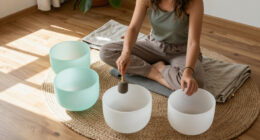


Learn to set up a crystal singing bowl, produce a steady tone with a mallet, and finish with safe cleaning and storage. This guide is for beginners using a bowl at home; no musical training is required. Allow 15–30 minutes for your first session, including setup and practice.

Turn your quiet moments into listening time
- Thousands of audiobooks, podcasts and originals
- Listen on your phone, tablet or Echo — also offline
- Cancel anytime

RYAN DVAN 432Hz 7-12 Inch Crystal Singing Bowl Set of 7
- ✔ Bowl count: 7
- ✔ Listed sizes: 7, 8, 8, 9, 10, 11, and 12 inches
- ✔ Listed notes: B, A, G, F, E, D, and C

CVNC Crystal Singing Bowl Frosted 432HZ Set Of 7 PCS 6-12 Inch White
- ✔ Bowl count: 7
- ✔ Listed sizes: 6, 7, 8, 9, 10, 11, and 12 inches
- ✔ Listed notes: B, A, G, F, E, D, and C

RYAN DVAN 432Hz 6"B 7"A 8"G Crystal Singing Bowl Set of 3
- ✔ Bowl count: 3
- ✔ Listed sizes: 6, 7, and 8 inches
- ✔ Listed notes: B, A, and G
Difficulty: Beginner | Time: 15–30 minutes
What You’ll Need
Tools & Materials:
- Crystal singing bowl
- Compatible rubber or silicone mallet
- Stable, level surface
- Non-slip ring or cushion sized for the bowl
- Soft, clean cloth
Knowledge:
- Basic awareness of your surroundings and comfort level with sound
Handle the bowl with clean, dry hands. Crystal bowls can chip or crack if struck against hard surfaces or handled roughly. Keep the bowl away from the edge of a table, pets, and anything that may knock into it. If you have sound sensitivity, tinnitus, or a condition affected by loud sound, begin quietly and stop if you feel discomfort.
RYAN DVAN 432Hz 7-12 Inch Crystal Singing Bowl Set of 7
This is our strongest all-purpose choice when we want a seven-bowl spread for individual practice, classes, or sound baths. Its listed sequence runs from a 12-inch C bowl down to a 7-inch B bowl, with D, E, F, G, and A between them. That gives us more note options than the three-bowl RYAN DVAN set, whose G, A, and B grouping is designed for a narrower arrangement. The size and note spread make the seven-piece set better suited to sessions where we want to move among multiple pitches rather than repeat a small cluster.Its accessories are geared toward keeping that larger collection manageable: two carrying cases, two suede strikers, a rubber mallet, seven O-rings, and six protective sleeves are listed. CVNC also offers seven bowls and two cases, but includes two rubber mallets as well as two suede ones. RYAN DVAN’s listing gives more detail about sleeves and says each bowl is individually tested; still, neither set supplies independent tuning measurements. The main tradeoff is straightforward: a seven-bowl set asks for more storage space and careful handling than the compact three-piece option, and the product details do not specify the exact dimensions of its cases.
Pros:
- Seven bowls spanning 7 to 12 inches with a broad listed note range.
- Two carrying cases plus six protective sleeves support organized storage.
- Includes both suede strikers and a rubber mallet.
- Manufacturer describes the bowls as individually tested to a 432Hz reference.
Cons:
- A seven-bowl collection takes more space and effort to transport than the three-piece set.
- The listing does not provide independent frequency tolerances or case dimensions.
- Only six protective sleeves are listed for seven bowls.
Best for: Practitioners, instructors, and home users who want seven notes and a broad size range for varied sessions.
Not ideal for: Buyers with limited storage or those who want a lightweight, minimal set for occasional personal use.
Bottom line: Choose this set when broad note coverage and organized storage matter more than keeping the kit small.
“Choose this set when broad note coverage and organized storage matter more than keeping the kit small.”
CVNC Crystal Singing Bowl Frosted 432HZ Set Of 7 PCS 6-12 Inch White
CVNC is the more accessory-rich seven-piece option. Like the RYAN DVAN set above, it pairs seven bowls with two carrying cases, but its sizes run from 6 to 12 inches. That extra-small 6-inch B bowl gives us a lower-footprint option within the set, while the listed notes cover C, D, E, F, G, A, and B. Compared with RYAN DVAN’s 7-inch minimum, CVNC offers a wider size span on paper, though the different size-to-note pairings mean buyers should compare the stated notes as well as the dimensions.The standout practical detail is the four-mallete setup: two suede mallets and two rubber mallets are included. That can be useful when we want to keep accessories paired with different bowls or have a spare available. CVNC describes its bowls as hand hammered for tuning precision and notes its manufacturing experience, but the listing does not give frequency tolerances or explain how each bowl’s pitch is verified. It also mentions two cases and mallets, while offering less detail than RYAN DVAN about protective sleeves or O-rings beyond seven rubber rings. This set makes the most sense when accessory variety and the 6-inch bowl are priorities; skip it if compact transport is the main goal, since three bowls are easier to carry and store.
Pros:
- Seven bowls cover listed sizes from 6 to 12 inches.
- Includes two suede mallets and two rubber mallets.
- Two carry cases and seven rubber O-rings are included.
- Manufacturer identifies sound practice, yoga, meditation, and related sessions as intended uses.
Cons:
- The listing does not provide measured pitch tolerances or independent tuning verification.
- Protective sleeves are not specified, unlike the RYAN DVAN seven-bowl listing.
- Seven bowls still require substantially more storage than the three-piece RYAN DVAN set.
Best for: Buyers who want a full seven-bowl set, a 6-inch bowl, and extra suede and rubber mallets.
Not ideal for: Those seeking the simplest lightweight setup or detailed, independently verifiable tuning specifications.
Bottom line: Pick CVNC when the 6-inch bowl and extra mallets matter more than detailed storage and tuning documentation.
“Pick CVNC when the 6-inch bowl and extra mallets matter more than detailed storage and tuning documentation.”
RYAN DVAN 432Hz 6"B 7"A 8"G Crystal Singing Bowl Set of 3
For a first setup or a practice space where every item needs a place, this three-bowl kit is the easiest of the lineup to live with. It groups 6-inch B, 7-inch A, and 8-inch G bowls in a padded carrying case and includes a suede striker, rubber mallet, and three silicone O-rings. The smaller collection gives us fewer pitches and less room for varied arrangements than either seven-bowl set, but it also reduces the number of bowls we need to position, store, and carry. That makes it a more focused choice for personal meditation or a small, portable session kit.Compared with the two seven-piece sets, this kit makes a clear compromise: it keeps a usable three-note group and drops the broader C-through-B coverage. The product information describes 99.99% frosted quartz and says the bowls are tuned and tested to an A4=432Hz reference, but provides no independent test results or stated tolerance. It also lists a single carrying case, which simplifies transport but offers less separation than the two-case arrangements of the larger sets. Choose it when portability and an intentionally small collection matter; if we need more tonal variety for group sessions, the other RYAN DVAN set or CVNC set is a better fit.
Pros:
- Three bowls in a compact 6-, 7-, and 8-inch grouping.
- Padded carrying case is included for storage and transport.
- Includes a suede striker, rubber mallet, and three silicone O-rings.
- Manufacturer describes the bowls as frosted, high-purity quartz.
Cons:
- Three notes provide less range than either seven-bowl set.
- One carrying case offers less separation for packing than the two-case kits.
- No independent tuning measurements or frequency tolerances are provided.
Best for: Beginners, travelers, and practitioners who want a three-note quartz set that is easier to store and carry.
Not ideal for: Sound bath leaders or players who need a broad range of notes for varied group arrangements.
Bottom line: This is the practical pick when carrying three bowls is more valuable than having a full seven-note range.
“This is the practical pick when carrying three bowls is more valuable than having a full seven-note range.”
As an Amazon Associate we earn from qualifying purchases.
Before You Start
Check the bowl for visible cracks or chips. Do not play a damaged bowl, since continued use may cause it to break. Place it where it cannot be bumped, and leave enough space to move the mallet around the rim without hitting nearby objects. Start at low volume; a bowl can sound much louder close up than expected.
Step-by-Step Instructions
Step 1: Choose a stable playing surface
Set the bowl on a level table or floor. Put a correctly sized non-slip ring or cushion beneath it so the bowl sits securely without rocking. Keep the playing area clear of hard objects.
Tip:Do not hold the bowl in your hand while playing. A steady base helps the tone ring and reduces the chance of dropping it.
Check: The bowl rests upright, does not wobble, and has clear space around its rim.
Step 2: Position yourself and the mallet
Sit or stand comfortably with the bowl within easy reach. Hold the mallet near its end with a relaxed grip. Use the soft, compatible end intended for your bowl; avoid metal or hard objects unless the bowl maker specifically recommends them.
Tip:Keep your face and ears at a comfortable distance. You can move farther away if the sound feels too strong.
Check: You can move your hand around the full rim without stretching or brushing the bowl with your fingers.
Step 3: Make a gentle test strike
Tap the outside of the bowl once with the mallet, using a small, controlled wrist movement. Aim for the side of the bowl rather than the rim or base. Let the sound fade before trying again.
Tip:Use only enough force to start a clear tone. A hard strike can create an unpleasant sound and may damage the bowl.
Check: The bowl produces a clear note without rattling, scraping, or an unusually sharp impact sound.
Step 4: Create a sustained tone around the rim
Rest the mallet’s soft surface against the bowl’s outer rim. Apply light, even pressure and move it slowly around the rim in one direction. Keep the mallet in contact with the bowl and use a steady pace. If the sound does not build, slow down or adjust the pressure slightly.
Tip:Do not press hard. Too much pressure can stop the bowl from resonating or make the mallet chatter against the rim.
Check: A continuous tone grows as the mallet travels around the rim, without repeated clacks or breaks.
Step 5: Adjust the sound gradually
Experiment with small changes to speed and pressure until the tone stays smooth. Pause between attempts to let the sound fade. If you want to change the pitch or character, use a different bowl rather than forcing more pressure onto the current one.
Tip:Some bowls respond best to a particular mallet and playing speed. Follow the maker’s care or playing instructions if they differ from general guidance.
Check: You can repeat a strike or rim movement and produce a tone that is comfortable and reasonably consistent.
Step 6: End the session and clean the bowl
Stop moving the mallet and let the tone fade naturally. Lift the mallet away, then wipe the bowl gently with a soft, dry cloth. If the bowl needs more cleaning, follow its maker’s instructions and avoid sudden temperature changes.
Tip:Do not pour water into the bowl or use abrasive cleaners unless the manufacturer says they are safe for that bowl.
Check: The bowl is dry, free of visible fingerprints or dust, and has no new damage.
Step 7: Store the bowl securely
Move the bowl with both hands, supporting it from underneath. Place it in a padded, stable location where it cannot roll, be stacked under heavy items, or be struck by other objects. Store the mallet separately so it cannot knock against the bowl.
Tip:If you use a fitted case, make sure the bowl is fully supported and does not shift inside it.
Check: The bowl rests securely with padding and enough clearance to prevent contact with nearby items.
Common Mistakes to Avoid
- Striking the bowl too hard. — Begin with a light tap and increase force only slightly if the tone does not start. Never hit the bowl with a hard object.
- Pressing heavily or moving too quickly around the rim. — Use light, even contact and a slow pace. If the mallet chatters, reduce pressure or slow down.
- Playing on an unstable surface or without a suitable cushion. — Use a level surface and a correctly sized non-slip ring so the bowl cannot wobble or slide.
- Using a damaged bowl or storing it where it can be bumped. — Inspect it before playing and store it with padding, away from edges and heavy items.
Troubleshooting
Problem: The bowl makes a short clack but will not sustain a tone.
Solution: Check that the bowl sits securely, then try a compatible soft mallet. Move it slowly around the rim with light, continuous contact; adjust the pace a little at a time.
Problem: The mallet skips, squeaks, or chatters against the rim.
Solution: Reduce pressure, slow your movement, and check that the mallet surface is clean and dry. If the sound continues, try the mallet recommended by the bowl’s maker.
Problem: The sound feels too loud or uncomfortable.
Solution: Stop playing, move farther away, and wait for the sound to fade. Resume more quietly only if comfortable; end the session if discomfort continues.
Problem: You notice a chip, crack, or new rough spot.
Solution: Stop using the bowl. Do not attempt to repair it for playing; contact the seller or manufacturer for handling advice.
What Success Looks Like
You have completed the task when the bowl remains stable on its cushion, produces a clear gentle strike and a sustained tone with controlled mallet movement, and is left clean and securely stored. You should be able to play without the mallet rattling and without discomfort from the volume.
Next Steps
Practice for a few minutes at a time, keeping the volume comfortable and allowing the sound to fade between attempts. Check the bowl and mallet for wear before each session, and follow the manufacturer’s instructions for cleaning and storage. If you add another bowl, give each one its own stable cushion and enough room to prevent contact.
Frequently Asked Questions
Do I need musical experience to play a crystal singing bowl?
No. Begin with a gentle strike and slow rim movement. Focus on a comfortable volume and a steady tone rather than musical technique.
Which mallet should I use?
Use a mallet with a soft surface that is compatible with your bowl. Bowl makers may recommend specific materials or sizes, so check their instructions if you are unsure.
Can I play the bowl while holding it?
For a beginner, place it on a stable, correctly sized cushion. Holding it can make it harder to control and increases the chance of dropping it.
How do I make the tone last longer?
Keep light, even contact with the rim and move at a steady, unhurried pace. If the tone breaks or the mallet chatters, adjust your pressure and speed slightly.
Can I put water in a crystal singing bowl?
Do not add water unless the manufacturer confirms that it is safe for your bowl. Water can affect the sound and may complicate cleaning or handling.